
Our expert Fire Risk Assessors have been carrying out Fire Risk Assessments and annual reviews for over 30 years.
In all types of business in London, Surrey and the South-East.
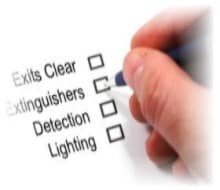
All businesses and blocks of flats must have a valid Fire Risk Assessment to comply with regulations – in fact, it’s the cornerstone of your fire safety plans.
Most importantly, regardless of the number of occupants, the findings of your Fire Risk Assessment must now be recorded in writing.
The ‘Responsible Person‘ is legally responsible for ensuring a suitable and sufficient Fire Risk Assessment is completed and kept up to date. This can be someone within the workplace; however, there is an added risk to conducting a fire risk assessment in-house, as most people don’t have the experience and knowledge to identify risks and poor fire safety standards.
If you’re unsure what a Fire Risk Assessment is, who needs one, or what it should include, for more information, please read our ‘What is a Fire Risk Assessment and Do I Need One?’ article.
Our team of Fire Risk Assessors have many years’ experience between them, so you can be confident they are adhering to the latest regulatory guidelines when they give you advice.
We will carry out a thorough assessment of your premises and provide a detailed report, including recommendations and a prioritised action plan.
As well as carrying fire industry accreditations, we are SafeContractor and CHAS approved and certified to ISO9001, so you can be confident that you will receive the best possible service and advice.
Book a Fire Risk Assessment from one of our expert assessors today – 01276 684473
How We Can Help
- Fire Risk Assessments available in London, Surrey and the whole of the South-East
- The company holds the accreditations detailed above, providing independent verification of its quality management systems, technical competence and commitment to industry best practice
- Our Fire Risk Assessors are registered with the National Fire Risk Assessors Register (NFRAR)
- All sizes and types of businesses
- Full audit of premises and procedures
- Easy to understand reports
- Action plan clearly outlined
- All legally required documentation supplied FRA reworks following building changes, change of use or change of occupancy
- FRA remediation – we can also help you act on the findings, from fire door upgrades to compartmentation and fire stopping works
- Assessments aligned to PAS 79-1:2020 for non-domestic premises and BS 9792:2025 for housing premises (which replaced PAS 79-2:2020)
- Proven track record delivering Fire Risk Assessments for organisations of all sizes, from small independent businesses to large multi-site organisations. Here is a link to one of our recent case studies: WH Brakspear & Sons – Fire Risk Assessments.
The fire risk assessor needs to be confident they can: –
– Correctly identify the potential causes of fire in the business
– Identify the people at risk
– Assess the suitability of fire safety measures in place, such as fire alarm systems and escape routes
– Assess the ongoing management of fire safety in the business, such as fire drills and staff training
– Develop a fire safety action plan if changes are needed
– Record all the significant findings
– Implement the action plan if one is needed
– Keep the assessment updated on an ongoing basis
A thorough fire risk assessment could mean the difference between top quality fire protection and putting your business and employees at risk.
If you’re in the London area and your fire risk assessment is due, or you’re concerned your How Often Should Fire Risk Assessments be Reviewed?, we can complete a full new assessment and provide the supporting documentation within 2 weeks, so that your business is kept fully up to date.
What a Fire Risk Assessment Involves
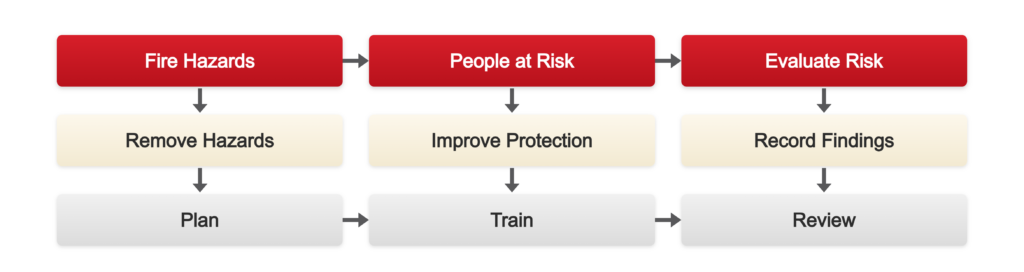
A properly conducted Fire Risk Assessment follows five structured steps, as set out in PAS 79-1:2020:
|
Step 1 |
Identify fire hazards |
Sources of ignition, fuel, and oxygen across your premises. |
|
Step 2 |
Identify people at risk |
Employees, visitors, residents, lone workers, and those with reduced mobility. |
|
Step 3 |
Evaluate, remove, and reduce risks |
Improve housekeeping, repair unsafe electrics, clear escape routes, improve signage. |
|
Step 4 |
Record, plan, and train |
Document findings, create your emergency plan, and ensure appropriate fire safety training is provided. |
|
Step 5 |
Review regularly |
Update after building changes, incidents, or at the intervals recommended for your building type. |
Our assessors work through each of these stages methodically, producing a clear written report and prioritised action plan on completion.
Fire Risk Assessments Across Different Building Types
We carry out Fire Risk Assessments for all types of premises across London, Surrey and the South-East.
The assessment approach – and the recommended review frequency – varies by building type and risk level:
|
Building Type |
Key Considerations |
|
Annual review recommended; Full reassessment typically recommended every 3 years for low-risk premises, or sooner where significant changes occur. |
|
|
Responsible Person (landlord or managing agent) accountable for communal areas. BS 9792:2025 applies |
|
|
High-risk premises: full FRA recommended annually under PAS 79-1:2020 guidelines. |
|
|
Schools & educational buildings |
Must account for vulnerable occupants and varying occupancy patterns. |
|
Hotels & hospitality |
High occupant turnover and sleeping risk – annual full assessment recommended. |
|
Warehouses & industrial |
Storage of combustible materials and heavy plant requires specialist assessment. |
|
Places of worship |
Often older buildings with complex layouts and volunteer management of fire safety. |
|
Holiday lets & short-term rentals |
Landlord obligations apply; written FRA required where 5+ regular occupants. |
Small businesses may also find our free Fire Risk Assessment Guidance and Template helpful.
FRA Reworks and FRA Remediation
When is FRA rework needed?
A Fire Risk Assessment should not be treated as a one-off exercise. A full FRA rework is required when:
- The layout or structure of the building has changed
- The use of the building has altered substantially
- The nature or number of occupants has changed significantly
- A fire or near-miss has occurred on the premises
- New equipment, processes, or hazardous materials have been introduced
- The original assessment is more than three years old (or one year for high-risk premises).
We carry out FRA reworks to the same standard as a full new assessment, with complete documentation provided.
FRA Remediation — Acting on the findings
An FRA report is only valuable if the action plan is implemented. FRA remediation means carrying out the physical fire safety improvements identified in your assessment. Common remediation works include:
- Fire Door Installation, upgrade, or replacement
- Fire Compartmentation works: sealing fire spread pathways between floors and rooms
- Fire Stopping – Closing penetrations around pipes, cables and ducts that pass through fire-resistant elements, as well as ensuring escape routes are enclosed with appropriate fire-resisting construction to maintain protected means of escape
- Intumescent seal installation around door frames and service penetrations
- Emergency lighting installation or upgrade
- Fire safety signage ensuring correct signs are in place at all required locations.
Surrey Fire & Safety can advise on and coordinate remediation works as a natural next step after your assessment, meaning your fire safety action plan is not just documented but delivered.
Call us on 01276 684473 to discuss your requirements.
Fire Risk Assessment London, Surrey & the South-East