
Wireless Fire Alarm Systems – Benefits & Applications
Wireless fire alarm systems have become an increasingly popular choice for businesses, property managers and building owners seeking a reliable, compliant and cost-effective fire detection solution.
Wireless Fire Alarm Systems
- Use secure radio signals instead of extensive cabling.
- Suitable for listed buildings, occupied premises and refurbishment projects.
- Can be installed with minimal disruption.
- Fully compliant systems are available to BS 5839-1 and EN 54 standards.
- Ideal for schools, healthcare facilities, offices, hotels and blocks of flats.
Advances in wireless technology have transformed these systems into a trusted alternative to traditional wired fire alarms, offering outstanding performance while significantly reducing installation disruption.
What are Wireless Fire Alarms?
Unlike conventional fire alarm systems that require extensive cabling between devices, wireless fire alarm systems use secure radio frequency (RF) communication to connect detectors, manual call points, sounders and control panels.
This enables faster installation, greater flexibility and easier system expansion, making them particularly suitable for occupied buildings where business continuity is essential.
What Types of Buildings are Wireless Fire Alarm Systems Suitable For? Heritage and listed buildings where preserving the building fabric is important or those with building restrictions.
Occupied buildings as well as complex sites with multiple buildings such as offices, healthcare facilities, schools and hotels where disruption must be kept to a minimum.
Commercial and industrial premises requiring a flexible fire detection solution.
For buildings which are likely to be renovated or extended in the near future or buildings undergoing refurbishment or extension where additional fire protection is needed without extensive rewiring.
For protection of blocks of flats where there are compartmentation or cladding issues.
Wireless fire alarm systems are often used as a temporary or long-term alternative to waking watch patrols in residential buildings. Where eligible, building owners may be able to access funding support through the Interim Measures Alarm Fund (IMAF) to help install suitable fire alarm systems. For businesses which would suffer disruption if they had to shut off areas of building. Temporary or modular buildings where systems may need to be relocated or expanded.
For buildings with difficult points of access such as narrow stairwells or high ceilings.
For buildings where aesthetics are important, such as high-end retail units.

Modern wireless fire alarm systems are designed to meet the same stringent safety and performance requirements as their wired counterparts, with solutions available that comply with BS 5839 and relevant EN54 standards.
When professionally designed, installed and maintained, they provide dependable fire detection and occupant protection while minimising disruption to day-to-day operations.
Whether you are upgrading an existing fire alarm system, extending protection to a new area or seeking a fully wireless solution for your premises, Surrey Fire & Safety provides expert wireless fire alarm design, installation, commissioning and maintenance services across London, Surrey, Berkshire, Hampshire and the South East.
Why Choose Surrey Fire & Safety for Wireless Fire Alarm Systems?
Wireless Fire Alarm Installation Across London, Surrey & the South East
Our experienced engineers design, install, commission and maintain conventional, addressable, hybrid and wireless fire alarm systems for a wide range of commercial, industrial and residential premises across Surrey, London, Hampshire, Berkshire and the whole of the South-East.
BAFE-registered and fully qualified engineers
Our engineers are trained in the latest wireless fire alarm technologies and receive manufacturer-approved training on the systems they install and maintain. Working in accordance with BS 5839-1, they deliver compliant, reliable and effective fire protection solutions for a wide range of premises.
Years of Knowledge and Experience
With more than thirty years of experience in the fire protection industry, we have successfully delivered fire alarm projects across a diverse range of sectors. Our expertise enables us to recommend practical, cost-effective solutions that provide long-term reliability and compliance.
Comprehensive Warranty for Complete Peace of Mind
All of our wireless fire alarm installations include a manufacturer’s warranty on equipment (excluding batteries), together with a 12-month parts and labour warranty on the installation itself.
Free Site Surveys and Professional Advice
We provide free site surveys to assess your building, understand your fire safety requirements and recommend the most suitable wireless fire alarm solution for your needs and budget.
Expertise in all property types
We have extensive experience designing and installing wireless fire alarm systems in HMOs, listed and heritage buildings, stately homes, offices, healthcare facilities, schools, factories, warehouses and commercial premises of all sizes.
Complete End-to-End Fire Alarm Service
From initial survey and system design through to installation, commissioning and certification, we provide a fully managed service.
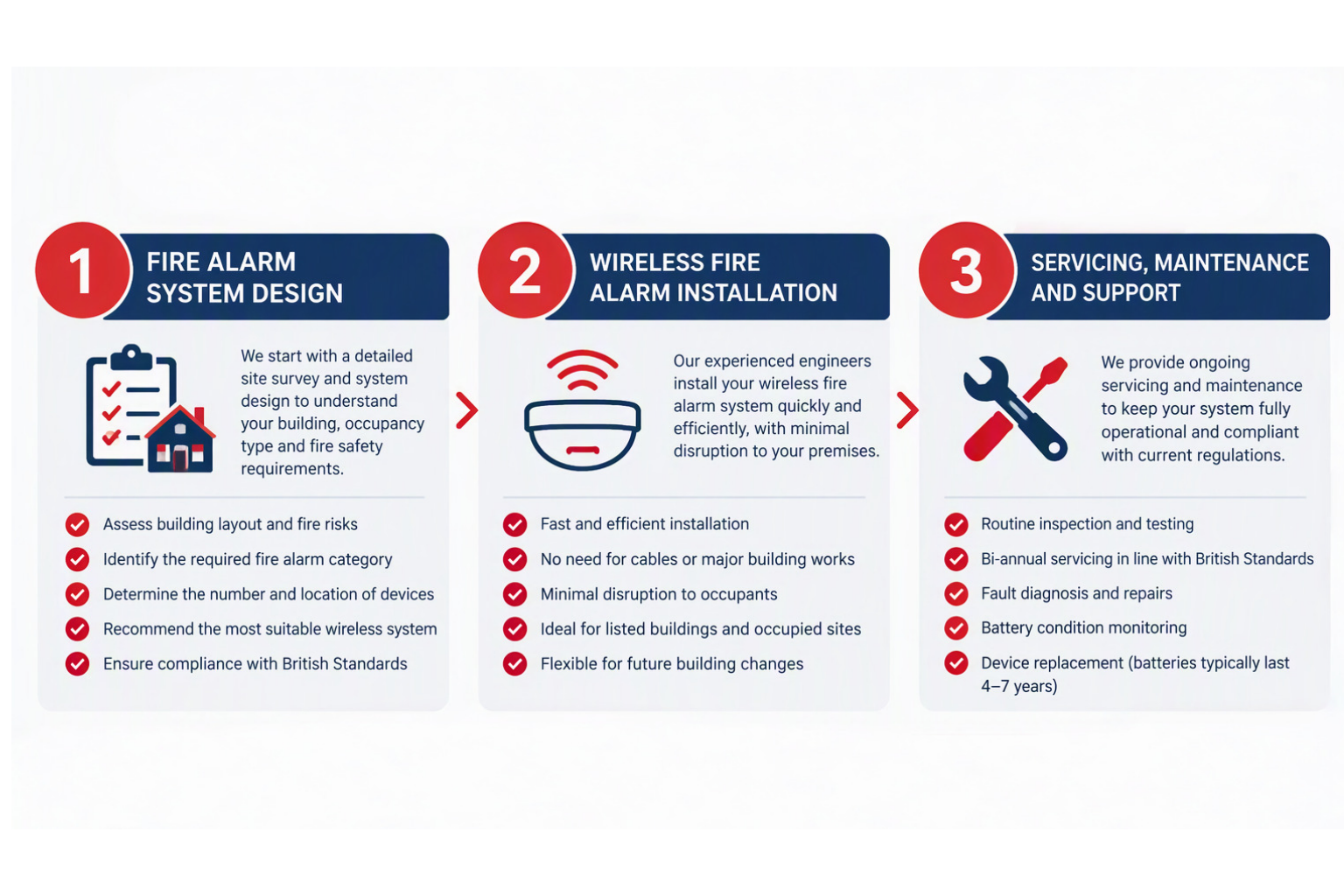
1. Fire Alarm System Design
Every wireless fire alarm installation begins with a site survey and fire alarm system design. We assess your building, occupancy type and fire safety requirements to determine the appropriate fire alarm category and system specification.
Once the assessment is complete, we’ll provide recommendations on the most appropriate solution for your building and budget.
2. Wireless Fire Alarm Installation
One of the main advantages of a wireless fire alarm system is the speed and simplicity of installation. Because there is no need to run cables throughout the building, installation can often be completed much faster than a traditional wired system.
3. Servicing, Maintenance and Battery Replacement
Ongoing maintenance, monitoring and support services are also available for continuous protection and compliance. We also offer flexible maintenance packages, including no-contract agreements, allowing you to choose the level of ongoing support that best suits your organisation.
Access to the Latest Wireless Fire Alarm Technology
We install EMS SmartCell and FireCell wireless fire alarm systems. As well as installing the latest innovative wireless fire alarm systems. We invest in the latest ongoing developments in connectivity, intelligent diagnostics and smart building technology to ensure every wireless fire alarm system is installed, commissioned and maintained to the highest standards. These include:
Smarter Building Integration – Integrate your wireless fire alarm systems with modern technologies such as access control systems, smoke ventilation, emergency lighting and building management systems
Remote Monitoring & Diagnostics – Cloud-based monitoring allows faults and system events to be identified more quickly.
Improved Battery Technology – Advances in battery technology are helping to extend device life and reduce maintenance requirements, making wireless fire alarm systems even more cost-effective and reliable.

Call us today on 01276 543354 to book a free site survey if you are based across Surrey, Berkshire, Hampshire, London or across the South-East so we can advise you on what your building needs – or use the contact form.
CASE STUDY
Installation of a Wireless Fire Alarm System at Stockwell Methodist Church, London
When the church’s existing fire alarm system failed, Surrey Fire & Safety designed and installed a new BS 5839-1 compliant wireless addressable fire alarm system.
- Church and Nursery Protected
- Wireless Addressable System
- BS 5839-1 Compliant
How do Wireless Fire Alarm Systems Work?
Wireless fire alarm systems provide the same level of fire detection and warning as traditional wired systems, but without the need for extensive cabling.
There are three separate parts of a wireless fire alarm system:
-
- Detection Devices: These are the sensors that detect fire or smoke. Examples include smoke detectors and heat detectors. When they sense danger, they activate the alarm system. Manual call points are also detection devices. Instead of relying on physical wires, devices such as smoke detectors, heat detectors, manual call points (the call point is the red box on the wall where you can raise the alarm if you spot a fire) and sounders or wireless infrastructure communicate with the fire alarm control panel using secure radio signals.
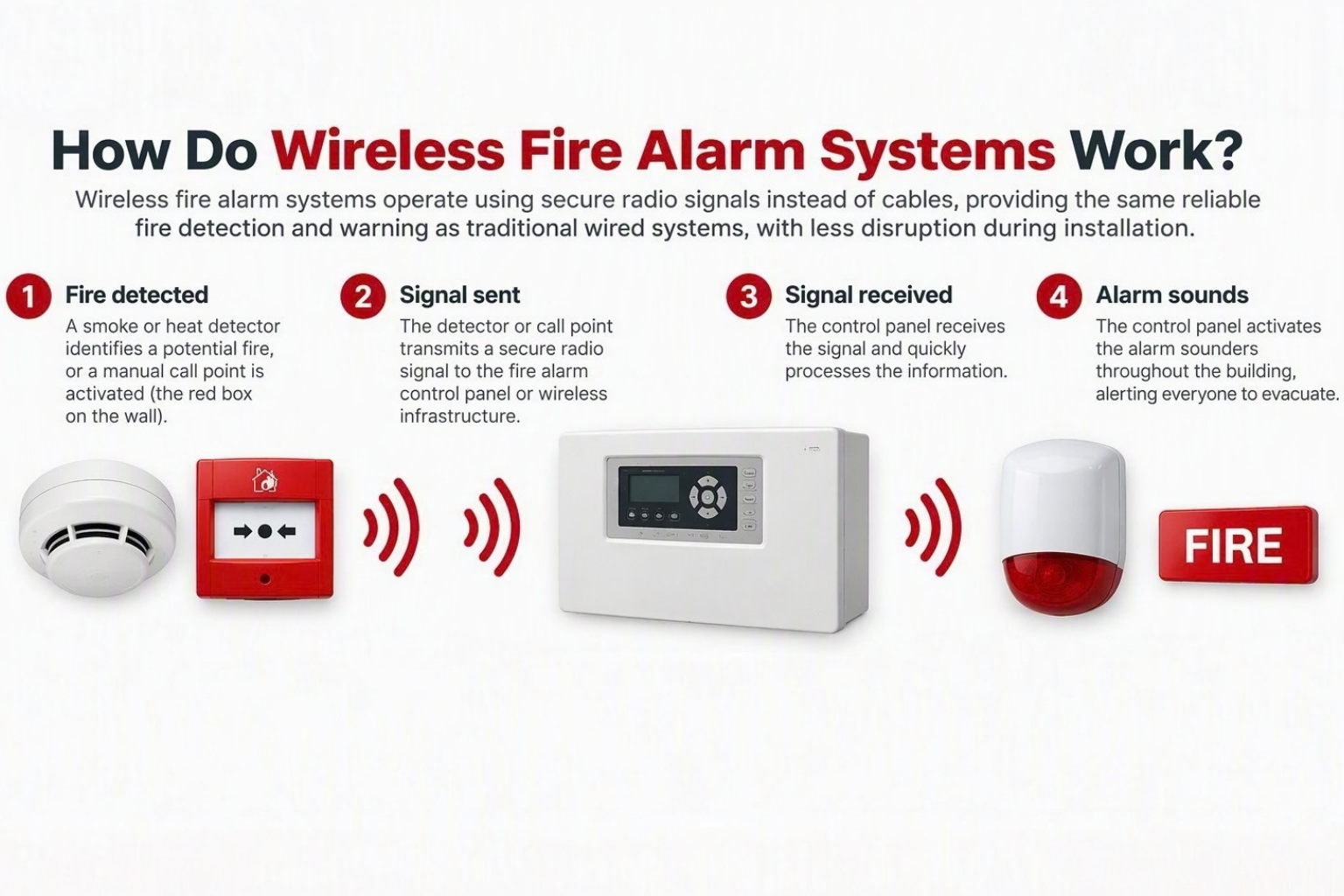
- Alarm Devices: When a detector identifies smoke, heat or another fire condition, it instantly transmits a signal to the control panel. The panel then processes the information and activates the appropriate alarm devices throughout the building, ensuring occupants are alerted quickly and safely. The alarm devices alert people about a fire. They include bells, electronic sounders and VADS (visual alarm devices) that let people know they need to evacuate.
- Detection Devices: These are the sensors that detect fire or smoke. Examples include smoke detectors and heat detectors. When they sense danger, they activate the alarm system. Manual call points are also detection devices. Instead of relying on physical wires, devices such as smoke detectors, heat detectors, manual call points (the call point is the red box on the wall where you can raise the alarm if you spot a fire) and sounders or wireless infrastructure communicate with the fire alarm control panel using secure radio signals.
Modern wireless systems continuously monitor communication between devices and the control panel, helping to maintain system reliability and quickly identify any faults.
Because there is little or no cabling required, wireless fire alarm systems can be installed with minimal disruption to day-to-day operations.
Wireless technology can also be used as part of a hybrid fire alarm system, combining wireless and wired devices to deliver a flexible and cost-effective solution tailored to the building’s requirements.
From the point of view of anyone using a building fitted with a wireless system, it works in exactly the same way as a ‘normal’ hard-wired system – you spot a fire, you break a call point; a call point breaks, the alarm sounds.
There’s no special training required and you’re protected in exactly the same way.
EMS Wireless Fire Alarm Systems
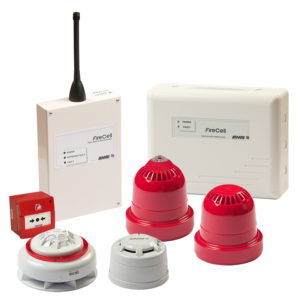
We install EMS SmartCell and FireCell wireless fire alarm systems.
EMS SmartCell Wireless Fire Alarm Systems
SmartCell is designed for small to medium-sized buildings and is an ideal solution where a fast, low-disruption installation is required. With support for up to 64 wireless devices, SmartCell provides reliable, fully compliant fire detection without the need for extensive cabling.
EMS FireCell Wireless Fire Alarm Systems
FireCell is designed for larger and more complex premises. Its scalable, analogue addressable architecture makes it suitable for buildings requiring higher device capacities, greater flexibility and the ability to expand as needs change.
Both systems provide fully compliant analogue addressable fire detection without the need for extensive cabling, helping to minimise installation disruption while maintaining the highest levels of protection.
So now you’ve got the facts, if you think a wireless system is for you, then please feel free to get in touch with us for your free survey and quote by calling us on 01276 684473 , or emailing us at [email protected]. Our friendly customer service team will be happy to help.
Wireless Fire Alarms Not For You?
Find out more about the different types of fire alarm system.
The Benefits of Wireless Fire Alarm Systems:
- As reliable as a wired system and certified to British and European standards.
-
Quick to install and can be fitted with minimum disruption to your business. Here is an example of a customer that needed an urgent upgrade to their existing non-compliant fire alarm system. Thanks to the flexibility of wireless technology, the upgrade, including designing, installing and commissioning the system, was completed in just one working day.
-
No need to shut down areas of the building or be open out of hours for the installation to take place.
-
No ugly cables or damage to your walls – the only cables are from the control panel to the mains power, and if required, from local supplies to boosters.
-
Can be easily installed in buildings where there is limited access e.g. due to high ceilings.
-
Layout is easily modified if something in your building changes, e.g. you extend or alter the layout.
-
Will save you money on labour, making good and decorating costs.
-
Will still work even if the power goes out as they are battery operated.
-
Can be used as a temporary system in locations where a wired one can’t be installed e.g. building sites.
-
Can be used to extend existing wired system,
-
Modern systems can integrate with fire doors, access control, smoke ventilation, remote monitoring services and building management systems, creating a more connected approach to life safety while providing real-time system visibility and improved maintenance capabilities.
What Our Customers Say
Katy Hughes
Town Clerk
Wokingham Town Hall
Wireless Vs Wired Fire Alarm Systems: Which Is Most Cost Effective?
Unsure whether a wireless system is the most cost-effective option? Read our guide: How Much Does It Cost to Go Wireless?
| Factor | Wireless Fire Alarm System | Wired Fire Alarm System |
|---|---|---|
| Installation Time | Fast installation with minimal disruption | Longer installation due to cabling requirements |
| Building Disruption | Low disruption to occupied buildings | More disruption from cable installation works |
| Listed & Historic Buildings | Ideal where building fabric must be preserved | May require intrusive cabling routes |
| Equipment Cost | Higher device costs | Lower equipment costs |
| Installation Cost | Often lower labour costs | Higher labour and cabling costs |
| Future Expansion | Easy to add, move or reconfigure devices | Additional wiring may be required |
| Best Suited For | Listed buildings, HMOs, occupied premises, refurbishments and temporary fire alarm systems | New-build developments and buildings where cabling is straightforward |
Wireless Fire Alarms – Frequently Asked Questions
There are, however, some things you might want to know beforehand to get a better understanding of what to expect and consider.
We prepared a short compilation of some of the common questions regarding wireless fire alarms below:
Are wireless fire alarm systems worth it?
If they meet your needs – absolutely. They offer plenty of value, including easier installation without any wiring, which is great for historical buildings. There’s also better scalability to adapt to changing needs and flexibility in picking the spots and positions for specific parts of the system.
How reliable are wireless systems compared to wired ones?
Modern wireless fire alarm systems are just as reliable. They utilise robust communication protocols to ensure secure and consistent operation. You can use them for a wide range of applications – from small residential settings to large commercial complexes.
What should I consider before installing a wireless fire alarm?
Before installation, it’s necessary to consider factors such as building layout, potential signal interference, battery life and compatibility with existing fire safety infrastructure. A site survey or a consultation with a professional can help address these considerations. If that’s what you need, you’re in luck – we offer both.
How often should I replace the batteries in a wireless fire alarm system?
Battery life varies depending on usage and environmental factors. Typically, batteries in wireless systems are designed to last several years. Regular maintenance and battery checks are still recommended to ensure optimal performance.
Can these wireless fire alarms be integrated with existing fire safety equipment?
Yes, more often than not it’s possible to integrate with existing fire safety equipment, including addressable systems and conventional zoned systems. Compatibility and integration capabilities may vary, so it’s advisable to consult with a qualified fire safety professional.
What can be done to prevent signal interference in my wireless fire alarm system?
To minimise signal interference, ensure devices are placed within recommended distances from each other and from potential sources of interference such as large metal structures or electronic equipment. Using quality components and conducting periodic signal strength tests can also help maintain reliable communication.
Are wireless fire alarm systems compliant with fire safety regulations?
Yes, they have to be. Wireless systems were designed and installed to meet regulatory standards and requirements. The key focus here is to design a whole system that adherence to these rules and guidelines, which obviously differs depending on specific building characteristics and layout.
How do you service wireless fire alarms?
We explain the steps below:
- Start with a regular inspection, check all the devices for damage and make sure they’re securely fixed.
- Perform battery checks frequently.
- Use a signal strength tester to verify effective communication between various elements of the fire alarm system and the control panel.
- Test all alarms and sensors to confirm they respond correctly.
- Keep the system’s firmware updated to maintain optimal performance and security.
Is it possible to expand my wireless fire alarm system as a building expands or changes?
Wireless fire alarm systems are designed precisely for that purpose – scalability. Adding new devices or expanding coverage areas is easy and can be done as needed. Give us a call when it’s time to make some adjustments and we’ll be happy to assist you with the whole process, including consultation and planning stage.
Is there any maintenance required for a wireless fire alarm system?
Regular maintenance is essential to ensure the ongoing functionality and reliability of any fire alarm system. This includes testing devices, checking battery levels, updating software as needed and conducting periodic inspections to verify system integrity.
What certifications should I look for in a wireless fire alarm installer?
When choosing a company to install a wireless fire alarm system, it is important to ensure they hold the appropriate industry accreditations and certifications. Look for providers with BAFE SP203-1 certification, experience working to BS 5839-1 standards and manufacturer-approved training on the wireless fire alarm systems they install. This helps ensure that radio signal surveys, device programming, commissioning and ongoing maintenance are carried out to the highest standards, giving you confidence that your fire alarm system will perform reliably when needed most.
We provide Fire Alarm Systems throughout the South East Including:
We deal with the four main types of fire alarm systems: conventional, addressable, wireless and hybrid.
London
Surrey
Berkshire
Hampshire
Woking
Reading
Slough
Bracknell
Guildford
Basingstoke
Croydon
Richmond
Wireless fire alarm systems in London, Surrey, Berkshire, Hampshire & across the South-East
Contact our customer service team today to schedule a consultation and learn more about how wireless fire alarm systems can enhance safety and protection for your property.


