
Wireless Fire Alarm Cost Guide
Wireless fire alarm solutions have a lot to offer. No wonder they’re so popular. Convenience, aesthetics flexibility. But, what’s the price for those benefits? How much does it actually cost to install a wireless fire alarm?
The cost of a wireless fire alarm system depends on the size of the building, the number of devices required, the fire alarm category and whether the project is a new installation or replacement system.
In many commercial buildings, wireless fire alarm systems are now comparable in cost to traditional wired systems because installation is significantly faster and less disruptive. For listed buildings, occupied premises, HMOs and temporary fire alarm installations, wireless systems can often provide better overall value.
For wired, the installation is the most expensive and time-consuming part. Wireless, on the other hand, are relatively easy to set up, but components are more costly.
Wireless vs Wired Fire Alarm Systems: Which Is More Cost Effective?
| Factor | Wireless Fire Alarm System | Wired Fire Alarm System |
|---|---|---|
| Installation Time | Fast installation with minimal disruption | Longer installation due to cabling requirements |
| Building Disruption | Low disruption to occupied buildings | More disruption from cable installation works |
| Listed & Historic Buildings | Ideal where building fabric must be preserved | May require intrusive cabling routes |
| Equipment Cost | Higher device costs | Lower equipment costs |
| Installation Cost | Often lower labour costs | Higher labour and cabling costs |
| Future Expansion | Easy to add, move or reconfigure devices | Additional wiring may be required |
| Best Suited For | Listed buildings, HMOs, occupied premises, refurbishments and temporary fire alarm systems | New-build developments and buildings where cabling is straightforward |
Fire Alarm Types
If you’re trying to decide whether or not to go wireless, it is not just a cost vs benefits dilemma, you need to decide what alarm system is correct for your circumstances. Here’s a brief overview of the main types of fire alarm:
- Wired Fire Alarms: Use physical wiring to connect detection devices throughout the property. These are more often used in new buildings since redoing existing wiring can be costly and very labour-intensive. Replacing a wired alarm can sometimes be cheaper than installing a new wireless fire alarm, if the existing wiring is up to standard. However, wired alarms take longer to install, and the installation process is significantly more disruptive, as well as being less aesthetically pleasing.
- Wireless Fire Alarms: Use wireless radio technology to link sensors and detectors without wires. They have the benefit that they are quick to install and preserve the fabric of the building, without the need to drill holes and fit wires. However, device batteries require replacement every four to seven years, meaning there’s a slightly higher ongoing cost.
- Hybrid Fire Alarms: Combine both wired and wireless components for improved flexibility in installation and connectivity. These are often a great option for adding devices to existing wired systems and offer the best of both worlds.
All these fire alarm installation options have their place in fire safety, it’s just a matter of making the right decision for your specific premises while making sure all the legal requirements are met. A fire alarm system has to meet the requirements of the relevant British Standards, first and foremost, for your premises to be safe and for you to meet regulations.
What Affects the Cost of Wireless Fire Alarms?
There are three main factors that determine the price of any fire alarm system – installation, components and finally ongoing maintenance and service. Sometimes it’s also monitoring in specific cases. But there are other important factors as well.
Here are a few of the most common ones that directly affect the price of a regulation-standard wireless fire alarm system:
The Size and Age of Your Building
Commercial structures come in different shapes and sizes, so the nature of your premises will factor into the final price. All the hardware aside, the price for installation is likely to increase the bigger the square footage of the building. However, this is also true for wired systems.
Components
The size of your building will determine how many components you need and this will affect the final price of your wireless fire alarm. Different manufacturers and brands offer different solutions at different price points, so we will always try to find a way to meet your budget.
There are three separate parts of a wireless fire alarm system:
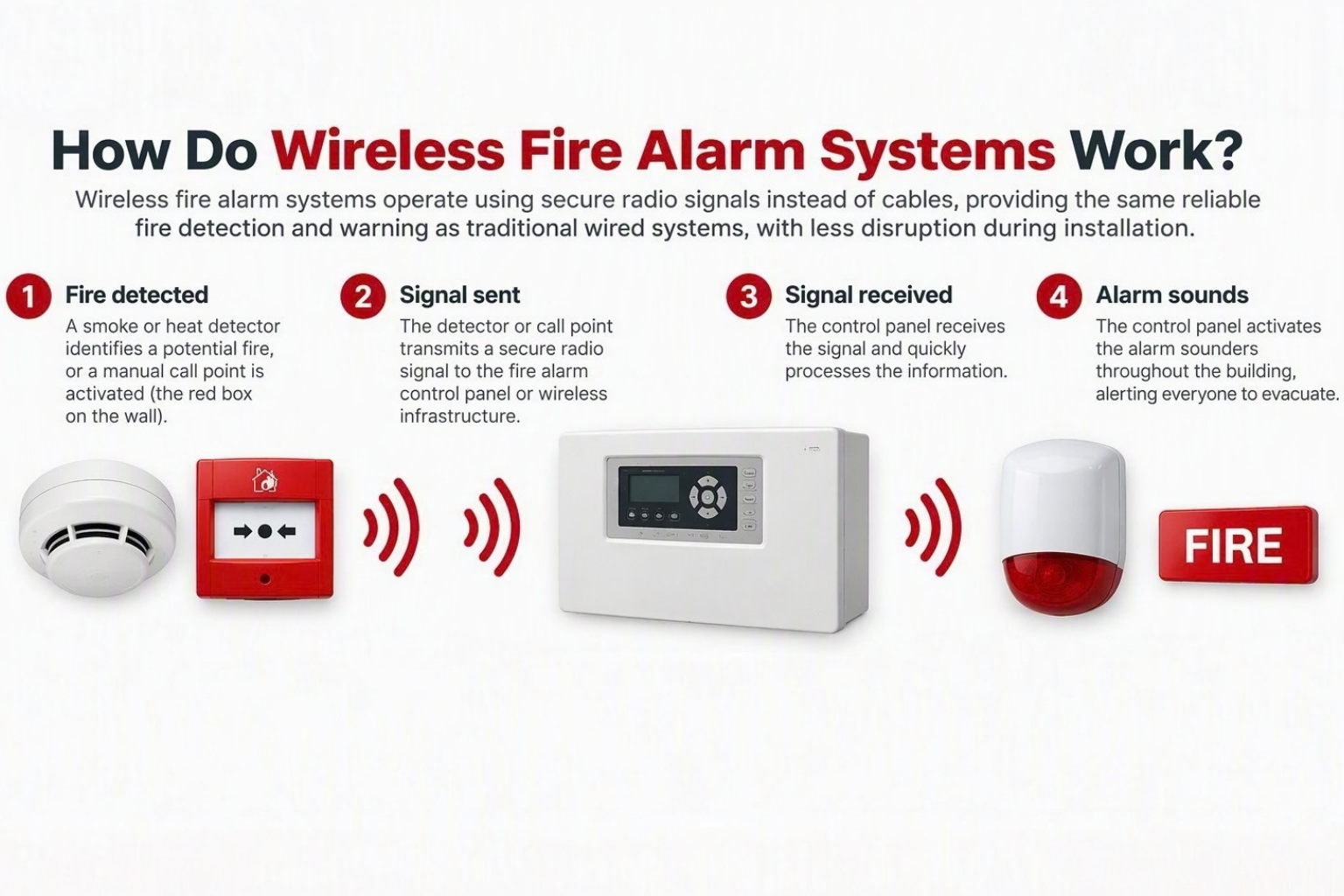
Detection Devices: These are the sensors that detect fire or smoke. Examples include smoke detectors and heat detectors. When they sense danger, they activate the alarm system. Manual call points are also detection devices.
Alarm Devices: These are the things that alert people about a fire. They include bells, electronic sounders and VADS (visual alarm devices) that let people know they need to evacuate.
Suppression Systems: These are systems that fight the fire For example, sprinklers or gas systems that release water or gases to extinguish the fire.
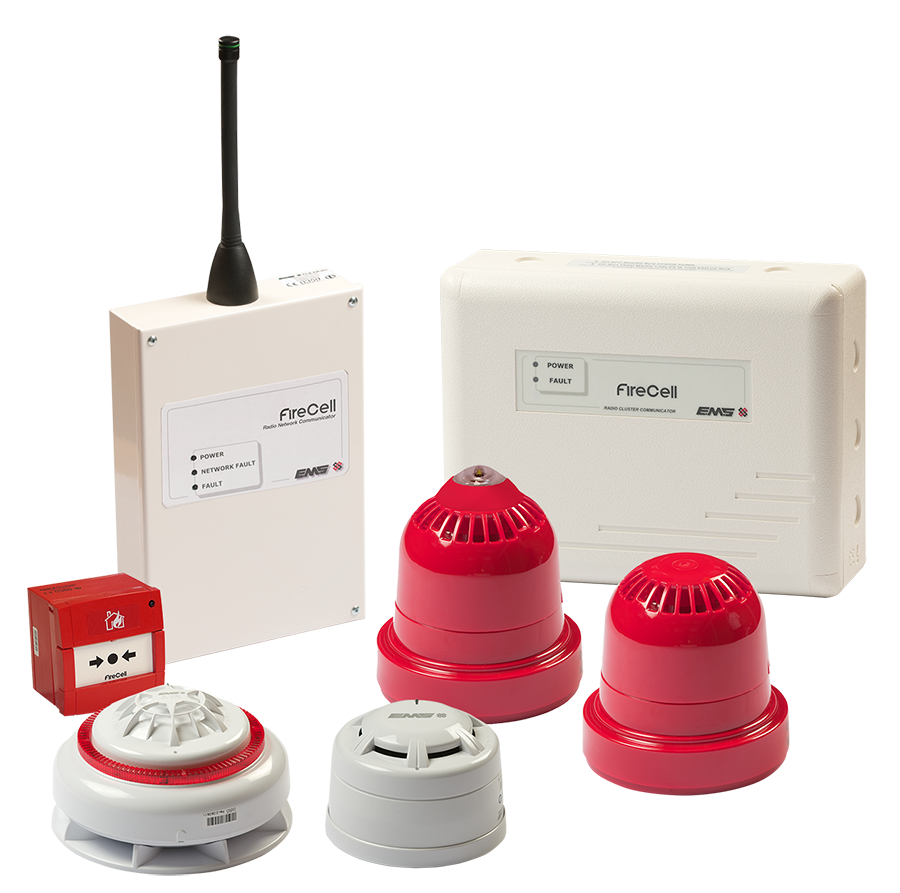
Here’s an overview of the individual parts a simple, yet effective fire alarm system should feature.
Control Panel: The central hub of the system that communicates with all the devices and tells you what the system is doing.
Manual Call Points: Also known as break-glass units, these allow individuals to manually raise the alarm by pressing the front of the unit.
Sounders and VADs (Visual Alarm Devices): Devices that alert occupants through audible and visual signals. VADs are essential for hearing or vision-impaired occupants or workers, or in areas with high ambient noise.
Expander Modules: With these, you can add more detection and alarm devices to improve the system’s coverage and capability.
How Do Surrey Fire & Safety Design, Install and Maintain Wireless Fire Alarm Systems?
The Design Stage
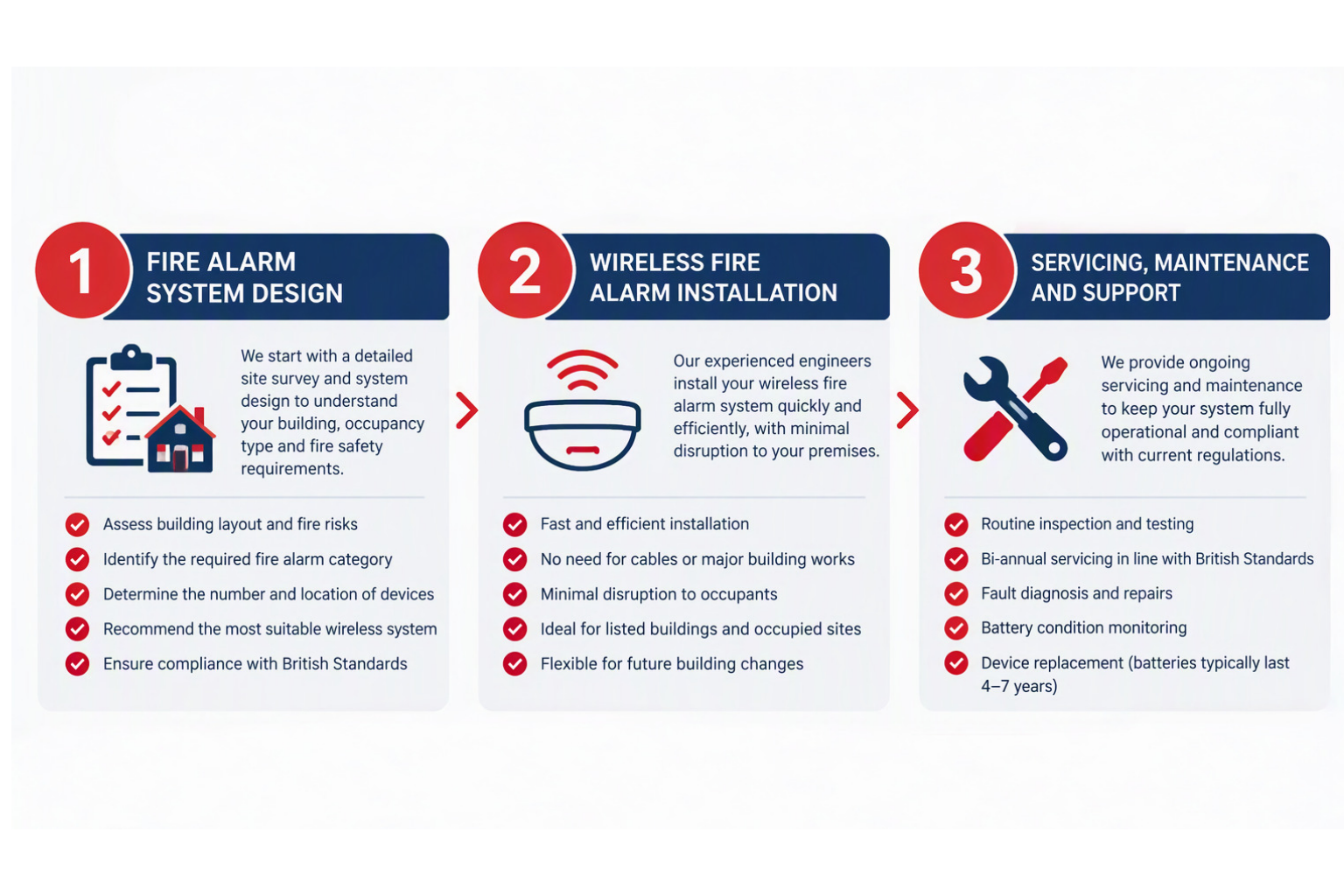
The first thing that needs to be done in order to install a regulatory-compliant fire alarm system for your building is the design stage. During this stage, we’ll consider what Grade and Category of system is required for your premises together with the infrastructure required to provide you with a reliable system. After the initial assessment, we’ll then recommend the right brand, model, and overall solutions for your building.
The Installation Stage
With wireless fire alarm solutions, the setup is much quicker compared to wired fire alarm systems and doesn’t involve any interference with the walls or other structural elements – there are no wires involved. That means you minimize the disruption to your business operations, which can also mean less disruption to revenues, for example, if you own a shop or service-based business.
Maintenance and Service
All fire alarm systems must be tested, serviced and maintained. The Regulatory Reform (Fire Safety Order) 2005 requires you to maintain all fire protection equipment provided in your premises. British Standards recommend that fire alarm systems are serviced at least every six months. Occasionally, parts require replacement. With wireless systems, the device batteries typically require replacement every four to seven years. However, modern wireless system batteries are standard lithium cells, so inexpensive to change.
Who Chooses Wireless Fire Alarms?
This a great solution for most applications and building types. Nevertheless, it’s true – there are specific instances where the value of wireless systems really shows. Here are some examples:
- Large Private Houses: These systems are perfect for spacious homes where traditional wiring might be cumbersome, disruptive – and unappealing. They allow for comprehensive coverage with no negative impact on the aesthetics.
- Houses of Multiple Occupation (HMOs): In properties like bedsits or shared accommodations, wireless systems provide effective fire safety with minimal installation hassles and plenty of sleek appearance.
- Listed Buildings: For historic structures where modifications to the fabric of the building are restricted, wireless fire alarms are invaluable. They ensure compliance with preservation laws while offering essential safety features without compromising the building’s integrity.
- Temporary Locations: They’re also ideal for temporary setups, such as construction sites or events. Their easy installation and removal make them suitable for areas where fire safety is needed only for a limited time.
Of course, this doesn’t mean other types of buildings would not benefit from a wireless installation.

Is the Cost of Wireless Fire Alarms Worth It?
Often wireless fire alarm systems are very much worth it. And here’s why:
Scalability
Offices grow bigger and smaller, and it’s easier to react to those changes with a wireless solution. It can be scaled up and down as you go on. Quickly, effectively, and with minimum disruption.
Convenience
Wireless alarms are a much more convenient solution with all the reliability and robustness of wired solutions– but with none of the hassle. They can also work well as a temporary solution.
Control
Let’s not forget a wireless system is addressable – just like its wired counterpart. ‘Addressable’ means that each device (such as a smoke detector or heat sensor) has a unique address that basically works as an identifier. This gives the control panel the ability to precisely identify the location of any activated device, so you can pinpoint the exact area of concern
Streamlined Look
Aesthetics are definitely a huge factor here. Modern workplaces appreciate and value modern, minimalist and streamlined look – and that’s exactly what you can expect with wireless solutions. Clean lines, saved space, and no unnecessary clutter.
Go Wireless with Surrey Fire & Safety
Designing an effective and up-to-standard fire alarm system is a bespoke service. And bespoke requires all the measurements and facts to make it fit to perfection. That’s why the quickest way to assess your overall costs is to contact industry professionals directly. Ensure that any supplier you use has the relevant experience of designing, installing and servicing these fire alarm systems.
Surrey Fire & Safety guarantee competitive prices, top-notch service and full customer satisfaction.
If you are considering a wireless fire alarm system and you are based in London, Hampshire, Surrey, Berkshire or anywhere in the South-East, we are happy to carry out a free survey of your premises. Where required, we will carry out a signal test to make sure that we select the correct hardware and we can then provide an accurate quotation.