
Fire doors deteriorate over time. That’s why regular fire door inspections are not just good practice. For most buildings, they are a legal requirement — with specific frequencies set by the Fire Safety (England) Regulations 2022, the Fire Safety Act 2021, and the Fire Safety Order 2005.
Regular inspections catch these defects early, ensuring:
- Fire doors perform for their rated period
- Escape routes remain safe
- Buildings stay compliant with UK fire regulations
Even a correctly installed door won’t protect if the surrounding fire compartmentation is compromised. Inspections help maintain the integrity of the wider passive fire protection system.
Our team carries out professional fire door inspections and surveys for residential, commercial, and industrial buildings across Surrey, London, and the South East.
Every inspection is component-level, fully documented, and produces a clear compliance report — so you know exactly where you stand and what needs attention.
Fire Door Inspection vs Fire Door Survey — What Is the Difference?
The terms are often used interchangeably, but in practice they describe two distinct scopes of work.
| Fire Door Inspection | Fire Door Survey | |
| Scope | Component-level check of individual fire doors | Full assessment of all fire doors in a building |
| Purpose | Ongoing compliance monitoring | Establish baseline or assess post-works compliance |
| Frequency | Quarterly, bi-annual, or annual programme | One-off: acquisition, refurbishment, or no existing records |
| Output | Door-by-door defect report with remedial recommendations | Building-wide compliance overview with prioritised remediation schedule |
| Best For | After a baseline has been established | Buildings without documented inspection history, or after acquisition or refurbishment |
Typically, the right approach is to start with a full survey to establish the baseline, then move to a structured fire door inspection programme from there.
We can advise on the appropriate frequency based on your building type and legal obligations.
What Our Fire Door Inspections & Surveys Cover
Every inspection follows the same structured, component-level process. For each door, our specialists check and document the following:
| What we check | What we look for | Common finding |
| Door leaf and frame | Damage, warping, misalignment, unauthorised modifications | Warped leaf preventing full closure; frame damage from impact |
| Gap measurements | Maximum 3mm around edges; 8–10mm at base depending on type | Excessive gaps from wear, warping, or poor original installation |
| Intumescent seals | Present, continuous, undamaged, correctly specified, not painted over | Missing seals; seals painted over; wrong specification for assembly |
| Cold smoke seals | Present, intact, not worn or compressed | Worn or absent — often omitted in older installations |
| Self-closing device | Closes and latches fully without assistance; correct closing speed | Door not latching; closer too weak for door weight |
| Hinges | Three fire-rated hinges; correctly fixed; no movement | Only two hinges; standard (non-rated) hinges; loose fixings |
| Glazing | Fire-rated glass; correct beading; no cracks or damage | Non-rated glass; incorrect beading; cracked panels |
| Signage | ‘Fire Door Keep Shut’ or ‘Fire Door Keep Locked’ on both faces; legible | Missing; wrong type; on one face only |
| Hardware | Locks, handles, hold-open devices — compatible and correctly fitted | Hold-open devices not connected to fire alarm; incompatible hardware |
| Overall operation | Door opens and closes freely; no obstruction to travel or closure | Dragging on floor; obstructions preventing full travel |
Every defect is recorded with its location, severity, and recommended remedial action – like fire door repair, or even if it’s beyond that point, new fire door installation.
Defects are prioritised — so you know what needs addressing immediately, what can be scheduled, and what is advisory only.
All findings are supported by photographic evidence.
How Often Must Fire Doors Be Inspected?
The inspection frequency required for your building depends on its type, height, and use. The table below sets out the legal requirements and industry best practice:
| Building type | Required frequency | Legal basis |
| Multi-occupied residential — common area fire doors (buildings over 11m) | Every 3 months | Fire Safety (England) Regulations 2022 — legal requirement |
| Multi-occupied residential — flat entrance doors | Annually | Fire Safety (England) Regulations 2022 — legal requirement |
| HMOs and domestic properties | Every 3–6 months | Best practice; annual full recorded inspection often required by landlords |
| Commercial premises (offices, warehouses, schools) | Every 6 months by specialist; monthly checks by building staff | Fire Safety Order 2005 — frequency set by fire risk assessment |
| High-risk buildings (care homes, hospitals, hotels) | Every 3–6 months by specialist; monthly functional checks | Fire Safety Order 2005 — higher frequency reflects occupancy risk |
| Any building — following building works | Immediately after any work affecting fire doors | Best practice; required before door is returned to service |
| Any building — following a reported defect | Without delay | Fire Safety Order 2005 — defective doors must be addressed promptly |
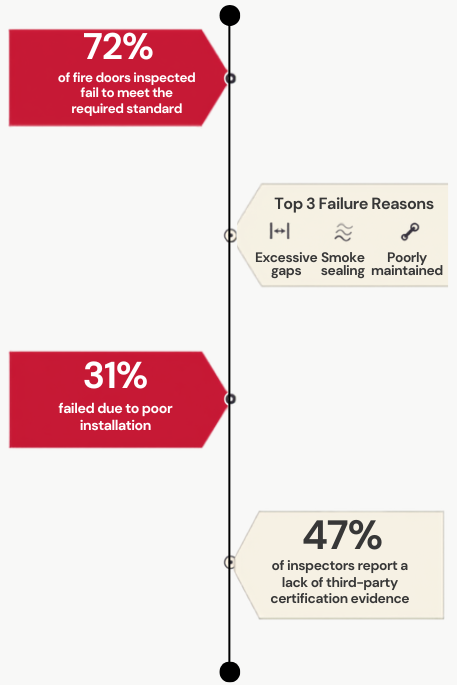
These are minimum requirements. Buildings with a history of defects, high occupant turnover, or recent refurbishment works may require more frequent checks.
The responsible person — whether that is a landlord, housing association, employer, or facilities manager — carries personal liability for ensuring inspections are carried out and defects addressed.
Failure to comply with the Fire Safety (England) Regulations 2022 can result in enforcement notices, significant fines, or in serious cases criminal prosecution.
Documented inspection records are the evidence that compliance has been maintained.
Fire Door Surveys & Inspection Services with Surrey Fire
- Qualified fire door inspection specialists — component-level assessments, not visual walkthroughs.
- FIA affiliated — independently verified to recognised standards.
- Clear, actionable reports — photographic evidence, prioritised recommendations, audit-ready format.
- Trusted by housing associations, facilities managers, and property managers across the South East.
- Full-service capability — inspections, surveys, maintenance, repairs, and installation all under one roof.
- Nearly 30 years of fire safety experience across commercial, residential, and industrial buildings.
Book Your Fire Door Inspection
Fire Door Inspections & Surveys — Frequently Asked Questions
Who can carry out a fire door inspection?
Fire door inspections must be carried out by a competent person — someone with the knowledge, skills, and experience to assess fire doors against the relevant standards and regulations. In practice, this means a trained fire door inspector rather than a general contractor or facilities maintenance operative. For buildings in scope of the Fire Safety (England) Regulations 2022, inspections must be carried out by a “competent person” — and documented records must demonstrate that competence. Third-party accreditation, provides objective evidence that an inspector meets the required standard.
What is the difference between a fire door inspection and a fire door survey?
An inspection is a periodic, component-level compliance check of individual doors as part of an ongoing programme. A survey is a comprehensive, one-off assessment of all fire doors in a building — used to establish a baseline, post-refurbishment compliance, or where no previous record exists. Most buildings start with a survey, then move to scheduled inspections.
Is a fire door survey a legal requirement?
The law requires fire doors to be maintained in effective working order. In multi-occupied residential buildings over 11 metres, specific inspection frequencies are set by the Fire Safety (England) Regulations 2022. A “survey” itself is not separately named in legislation — but a documented assessment is often the only practical way to demonstrate compliance.
What British Standards apply to fire door inspections and surveys?
Key standards include BS 8214 (installation and maintenance of timber fire doors), BS EN 1634-1 (fire resistance testing), and BS 9999 (fire safety in building management). Inspections are carried out against these standards alongside the Regulatory Reform (Fire Safety) Order 2005 and the Fire Safety (England) Regulations 2022.
How long does a fire door inspection take?
It depends on the number of doors and the building layout. As a guide, a competent inspector will typically assess 15–25 doors per day where full component-level checks and photographic records are required. Larger or complex buildings may require multiple days.

