
Fire door compliance is not a single certificate or a one-off check. It covers three separate obligations:
- routine checks of the doors already in place,
- a fire risk assessment that determines what doors and ratings a building actually needs,
- certification confirming the doors themselves meet the required standard.
A building can pass one of these and still fail the others. Confusing the three is the most common compliance gap we see – a building with up-to-date routine checks can still be non-compliant if the underlying fire risk assessment was never carried out, or if a door installation was completed without the right certification for its location.
Get in TouchThe Three Layers of Fire Door Compliance
Each layer is checked separately, by different people, against different requirements – which is exactly why a building can satisfy one and still fail the others.
1. Routine Checks (Fire Safety (England) Regulations 2022)
For buildings containing two or more domestic premises with shared common parts, Regulation 10 requires routine visual checks of fire doors: flat entrance doors checked at least every 12 months, and fire doors in communal areas – stairwells, lobbies, corridors, plant rooms – checked at least every 3 months where the building’s top storey is above 11 metres.
These checks are deliberately simple. They confirm the door hasn’t been damaged, that seals and self-closers are intact, and that gaps haven’t widened beyond tolerance. They are not a substitute for a fire risk assessment – Regulation 10 checks assume the doors were already correctly specified; they don’t establish that in the first place.
2. FRA (Regulatory Reform (Fire Safety) Order 2005)
The Fire Safety Order requires every building’s responsible person to ensure a suitable and sufficient fire risk assessment is in place. This is what determines which doors need to be fire-rated, what rating each one requires (FD30, FD60, or higher), and where compartmentation depends on the door performing correctly.
If a fire risk assessment hasn’t been carried out, or is out of date following building works, routine checks alone cannot confirm compliance – there’s no baseline to check against.
3. Door Specification and Certification
The door itself must be a certified assembly – leaf, frame, seals, hinges, and any glazing tested together as a system – to BS 476 or BS EN 1634-1, specified and installed in line with BS 8214’s code of practice, by a competent person. A fire-rated leaf in a non-rated frame, or a door missing its certification documentation, is not compliant even if it appears intact on a routine check.
This is also where a fire door certificate of compliance comes in: documentation confirming the specific door assembly installed matches a tested, certified system. Without it, a responsible person has no way to demonstrate compliance if challenged by a fire authority or insurer.
A closed door can hold a room under 100°F while the room next door tops 1,000°F in the same fire – and keep carbon monoxide near 100 ppm versus 10,000 ppm with the door open. That’s the practical reason all three layers matter: a door that isn’t correctly specified, isn’t certified, or isn’t properly maintained doesn’t deliver that protection when it’s needed.
What Happens If Your Fire Doors are Not Compliant
A failed routine check, or a defect found during fire door inspections & surveys, doesn’t automatically mean replacement. It means a decision needs to be made, based on what’s actually wrong:
- Defects that are usually repairable – worn seals, a faulty closer, loose hinges, missing or damaged signage, minor gaps within tolerance. These are addressed through fire door maintenance & repairs, re-certified, and documented without removing the door.
- Defects that require retrofit, not full replacement – the door itself is the wrong rating for its location, or sits in a non-rated frame. This means replacing the non-compliant assembly with a correctly specified one, without a full refurbishment of the surrounding opening.
- Defects that require full replacement – the door leaf is structurally damaged, has been altered in a way that invalidates its certification, or no certification can be established at all. At this point, repair isn’t a compliant option regardless of cost.
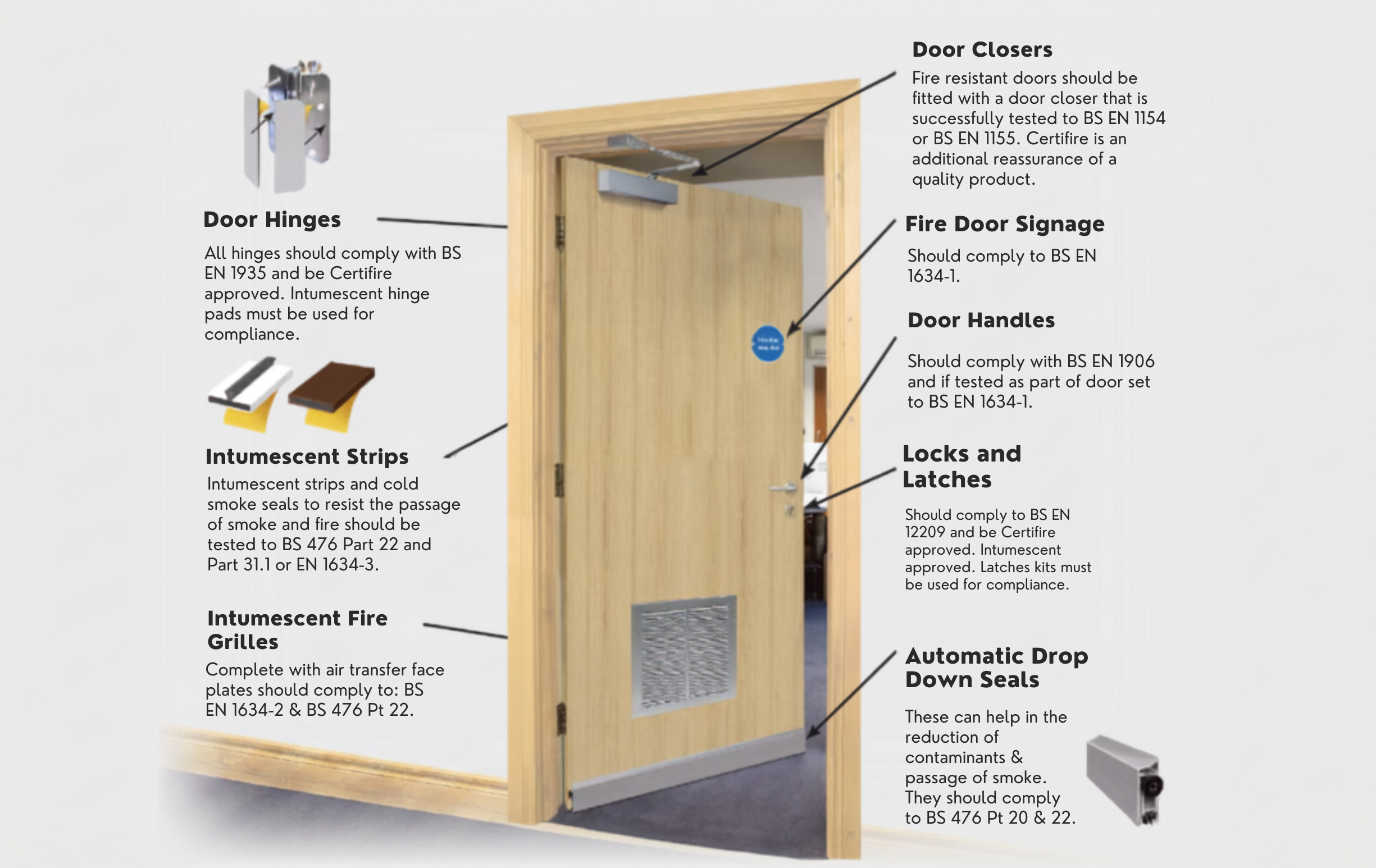
Whichever route applies, the outcome is the same: a written record showing what was found, what was done about it, and confirmation the door now meets its required rating. That record is what closes the compliance gap, not the repair work alone.
Contact UsWho Is Responsible for Fire Door Compliance?
The “responsible person” – typically the landlord, freeholder, employer, managing agent, or facilities manager with control of the premises – carries personal liability for all three layers above.
This responsibility applies whether the building is commercial, industrial, or residential, and cannot be delegated away simply by appointing a contractor; records, reviews, and remediation still need to be actively managed.
Failure to comply can result in enforcement notices, fines, or criminal prosecution, particularly where a breach places residents, staff, or visitors at risk.

Fire Door Compliance with Surrey Fire & Safety
 Full compliance picture, not just a checklist – we assess routine condition, specification, and certification together, not in isolation.
- Clear documentation – photographic evidence and written reports that stand up to scrutiny from building control, the fire authority, or insurers.
- Honest remediation advice – where a door can be brought into compliance through fire door maintenance & repairs, we say so; where it can’t, we explain why and what’s needed.
- Full-service delivery – fire door installation, inspection, and maintenance all under one roof, so compliance gaps are closed rather than just identified.
- Nearly 30 years of experience across commercial, residential, and industrial buildings throughout London, Surrey, and the South East.
 Full compliance picture, not just a checklist – we assess routine condition, specification, and certification together, not in isolation.
Contact Us
Fire Door Compliance – Frequently Asked Questions
What makes a fire door compliant?
A fire door is compliant when three things are true together: it’s the correct fire rating for its location as determined by a fire risk assessment, it’s a certified assembly installed correctly by a competent person, and it’s being routinely checked to confirm it remains in that condition. A door can fail compliance even if only one of these three is missing.
Do I need a fire door compliance certificate?
There’s no single national “compliance certificate” that covers a whole building. Instead, compliance is evidenced through a combination of documents: the fire risk assessment, installation certification for each door assembly, and routine inspection records. Together, these form the evidence a responsible person needs if compliance is ever challenged.
How do I know if my fire doors are compliant?
The most reliable way is through fire door inspections and surveys, which check specification, certification, and condition against current regulations in one assessment. If your building has never had a structured survey, or it’s been some time since the last one, that’s the right starting point before relying on routine checks alone.
Arrange a callback