
A fire door is one of the most important passive fire protection measures designed specifically to resist fire and smoke for a set amount of time.
Surrey Fire & Safety provides fire door installation, inspection, and maintenance for commercial, residential, and industrial buildings across London, Surrey, and the South East.
Most people walk through fire doors dozens of times a day without a second thought. That’s by design — but it also means faults go unnoticed, and a door that looks fine may not perform when it matters.
Every single component matters for the optimal fire door performance.
Our qualified specialists cover everything from initial installation through to ongoing compliance inspections and remediation works.
Contact one of our Fire Door Specialists today – 01276 684473
Fill out a Contact Form with your Enquiry
Our Fire Door Services
We provide a complete fire door service — from initial installation through to ongoing inspections, maintenance and repairs and ensuring that your fire doors are compliant.
Use the links below to see full details on what is involved, what the legal requirements are, and what you can expect from us for each service in our offer.
| Service | What’s involved |
| Fire Door Installation | Supply and installation of certified fire door assemblies, correctly specified for each location — leaf, frame, seals, closer, hinges, and glazing, all installed by qualified specialists. We supply and fit as one job, so certification covers the whole assembly rather than components from different suppliers. |
| Fire Door Inspections & Surveys | Component-by-component assessment of every fire door in your building, with photographic evidence and a written compliance report. Carried out to meet legal inspection frequency requirements. Reports are formatted for building control and insurers, not just for our records. |
| Fire Door Maintenance & Repairs | Remediation of defects identified during inspection — seal replacement, closer adjustment, rehinging, and full door replacement where necessary. Clear repair vs replace guidance every time. We work from your existing inspection report, so findings are remediated rather than reassessed from scratch. |
| Fire Door Compliance | Independent assessment of fire door compliance against current fire safety legislation, British Standards and manufacturer certification requirements. Ideal for responsible persons, facilities managers and building owners seeking evidence of compliance. We identify deficiencies, prioritise remedial actions and provide clear guidance to help you meet your legal fire safety obligations. |
What Is a Fire Door?
A fire door is a certified door assembly that is designed and tested to resist the spread of fire and smoke for a defined period of time — typically 30 or 60 minutes, though 90 and 120-minute ratings exist for higher-risk locations.
The key word is assembly. A fire door is not just a door leaf. It is the complete combination of the leaf, the frame, the intumescent seals, the cold smoke seals, the self-closing device, the hinges, and any glazing — all tested together as a system.
If a single component is compromised – so is the certified performance.
As a part of a broader fire compartmentation strategy, fire doors serve several critical functions simultaneously:
- Containing fire
- Keeping escape routes clear of smoke
- Maintaining fire compartmentation
- Supporting firefighting operations
Fire doors work in combination with fire stopping, cavity barriers, and fire-resistant walls and floors to contain a fire long enough for safe evacuation.
A fire door must:
- Close by itself
- Have intumescent (expanding) seals
- Be correctly installed
- Be kept free from damage
- Never be wedged open
Our experts cover all of the above, making sure you’re protected, safe – and fully compliant.
How Do Fire Doors Work?
In normal use, a fire door behaves like any other door. The difference becomes clear as soon as the fire breaks out.
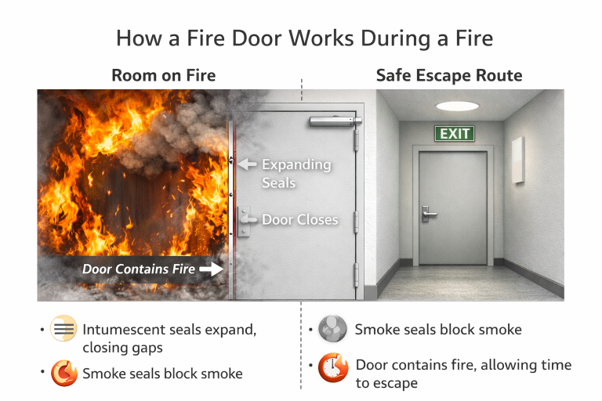
- Intumescent Seals Activate – As heat rises, the seals around the door leaf expand, closing gaps and preventing fire from passing through.
- Smoke Seals Work Continuously – Cold smoke seals block smoke at normal temperatures, stopping it from spreading before fire even reaches the door.
- Self-Closing Device Ensures Protection – The door automatically returns to the closed and latched position after every use. A door that is propped open or fails to close fully offers no fire protection.
Fire Door Ratings
Fire door ratings indicate how long the complete assembly has been tested to resist fire under controlled conditions.
The correct rating for any given location is determined by the building’s fire strategy, layout, and use.
| Rating | Protection | Typical locations | Who needs it |
| FD30S | 30 minutes | Flat entrance doors, protected corridors, escape routes, internal compartmentation in many residential and commercial buildings | Most residential and commercial buildings |
| FD60(S) | 60 minutes | Plant rooms, protected stair cores, basement escape routes and higher-risk commercial areas | Larger commercial buildings, blocks of flats |
| FD90 | 90 minutes | Certain service risers, high-risk industrial processes and specialist compartmentation requirements | High-risk commercial and industrial |
| FD120 | 120 minutes | Critical infrastructure, major service risers and locations where the fire strategy requires extended fire resistance | High-rise residential, critical infrastructure |
Most residential buildings, like social housing, and standard commercial premises like, offices require FD30S doors as a minimum.
The correct fire rating cannot be determined solely by building type. A high-rise residential building, commercial office or industrial facility may contain a combination of FD30S, FD60S, FD90 and FD120 fire doors depending on its fire strategy and compartmentation requirements.
If you are unsure what rating is required, our fire door inspectors and installers verify that every door is correctly specified, certified and suitable for its location within the building.
If you are unsure what rating is required in your building, our installation and inspection teams verify that every door carries the appropriate rating for where it is fitted — not just that a door is present.
Fire Door Types – Internal Fire Doors vs External Fire Doors
The fire door installation and fire door maintenance requirements for both internal and external options are consistent.
| Internal Fire Doors | External Fire Doors |
| Most common type in UK buildings. Used internally to maintain fire compartmentation: corridors, stairwells, flats, offices, plant rooms. Typically timber-based FD30S, rating depends on location. | Fitted at entrances, exits, and external openings. Usually steel-faced for fire and weather resistance. Used as final exits, loading bay, and plant area doors. Rating must match exposure conditions. |
Quick-Reference Guide to Fire Door Components
A fire door assembly is only as strong as its weakest component.
The table below sets out every element that must be present, what it does, and how it most commonly fails.
Our installation and inspection teams check every one of these on every door.
| Component | What it does | Common failure |
| Fire-rated door leaf | Resists fire and heat for the rated period (FD30, FD60, etc.) | Wrong rating for location; unauthorised modifications |
| Fire-rated frame | Part of the tested assembly — the leaf alone is not enough | Non-rated frame fitted with rated leaf |
| Intumescent seals | Expand under heat to seal the gap between door and frame | Missing, damaged, or wrong specification |
| Cold smoke seals | Block smoke at ambient temperatures, before heat activates intumescent seals | Worn, missing, or omitted entirely |
| Self-closing device | Ensures the door closes and latches fully every time without assistance | Not closing fully; adjusted or removed |
| Fire-rated hinges | Minimum three steel hinges; standard hinges are not acceptable | Incorrect hinges; only two fitted |
| Fire-rated glazing | Where glass panels are present, must be fire-rated and correctly installed | Non-rated glass; incorrect beading |
| Signage | ‘Fire Door Keep Shut’ or ‘Fire Door Keep Locked’ as required | Missing, wrong type, or illegible |
Visit our dedicated Fire Door Inspection page to learn more about what our inspectors check and why to book a consultation.
Fire Door Regulations
Fire door regulations in the UK are primarily governed by Building Regulations Approved Document B, which sets out the requirements for fire door placement, performance, and specification in new and refurbished buildings.
For buildings already in use, the Regulatory Reform (Fire Safety) Order 2005 requires the responsible person to maintain fire safety measures — including fire doors — in effective working order. This means regular inspection and prompt remediation of any defects found.
The Fire Safety Act 2021 and Fire Safety (England) Regulations 2022 introduced specific additional requirements for multi-occupied residential buildings:
- Quarterly checks of all fire doors in common areas for buildings over 11 metres
- Annual checks of every flat entrance door leading onto a common area
- Written records of all inspections, available for audit by the fire authority
- Prompt remediation of any defect identified — waiting for the next scheduled inspection is not sufficient if a problem has been reported
Failure to comply can result in enforcement notices, significant fines, or criminal prosecution.
The responsible person — whether that is a landlord, housing association, employer, or facilities manager — carries personal liability for compliance.
To comply with UK regulations, a fire door must:
✔ Be the correct fire rating (FD30 / FD60)
✔ Have fully functioning self-closer
✔ Have 3 fire-rated hinges
✔ Have no more than 3mm gaps around edges
✔ Have 8–10mm gap at the bottom (depending on type)
✔ Have intumescent and smoke seals
✔ Have correct signage
✔ Be kept closed, not wedged open
✔ Be installed and certified by competent persons
Which British Standards Apply to Fire Doors?
- BS 8214 — Fire-Resisting and Smoke Control Door Assemblies
Provides guidance on the specification, installation, inspection, maintenance and use of fire doors. - BS 476 (Parts 20 & 22) — This is a general methodology for Fire Resistance Testing
Tests how long a fire door resists fire:- BS 476-20: general fire resistance testing
- BS 476-22: testing door and shutter assemblies
Most older UK fire doors were tested under this standard.
- BS EN 1634-1 — Fire Resistance Fire Door Testing
European/UK standard for fire resistance of door sets; most new fire doors are tested to this. - BS 9999 — Fire Safety in Design & Management
Provides guidance on fire door use in buildings, including signage, function, and escape routes. - Approved Document B — Building Regulations
Legal requirements for fire door placement and performance in new and refurbished buildings.
